
Episode 2: Crybully
Originally published on Tuesday, April 1, 2025
The next phase of abusive tactics: DARVO
You can brand someone as an abuser in an attempt to change the narrative of how you acted, but there's always the danger that someone will have documentation of it.
Predictably, the most recent act in Audrey's passion play consists in painting us as the abusers. Audrey, once again, leverages mental health stigma and ableism in claiming my husband's ADHD-length posts are 'erratic' and 'angry.' I believe the evidence I have outlined in this blog post bears witness as to who is the one who has acted with cruelty, and who has desperately tried to control the narrative, tried to intimidate others into silence, and has tried to erase the trace of her own actions.

Since we already have summoned Brandolini's spirit in the previous blog post (admittedly, he is still alive as far as we know), it follows that we should close the circle by repeating the ritual and touching the points Audrey is making in her four-skeet diatribe -or is it only a diatribe when others go at length about something? If one is the perpetrator, does it become a sparkling nagifesto instead? (After all, her girlfriend fired off a nineteen-skeet post fifteen days ago as part of an argument- managing, somehow, to not be called 'manic' or 'meandering' or 'erratic' by Audrey, reinforcing my observation in the previous blog entry about a tactic Audrey, Mrs. Kerzner and Poppy share in common.)
Taking A Closer Look
What Audrey is doing right off the gate is a classic case of DARVO. I will substantiate this claim by making the following observations on her points:
- Abusers hate it when you stand your ground and call them out: If you follow the flow of the events, we have already established and documented that Saige and Audrey insisted that we had no claim to consider ourselves targeted by Poppy. That doing so diminished their victimhood and, when we refused to accept their speaking over us on what it was that we actually experienced, they included us in a list and made numerous posts commenting about us.
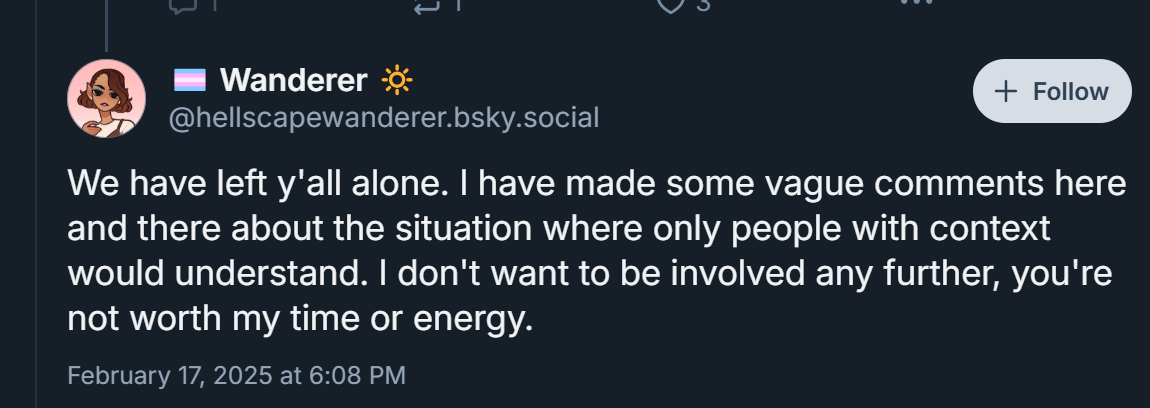
- Abusers get erratic and angry when you don't shut up and take it: We responded to Audrey and Saige's re-writing of history by posting documentation proving that her claims were, in fact, a lie. The fact that we responded in the same kind that they did- by using our timelines and speaking up about our experiences (but, unlike them, with documentation) clearly has angered them because we were supposed to be silent and take it. Audrey claims she has given us 'chances to leave them alone'- which we have done, as we have not circumvented their blocks to interact with them directly. But that is not what they mean by 'leaving them alone'- they object to us talking about them and about the events that took place in our own timelines while they do the same. This is beside the point that, by this definition, Audrey and Saige have not 'left us alone' either. This is a repeated pattern for Audrey, where she demands no engagement from others while engaging in vague comments about them (screenshot from a different altercation with a different party), where 'engagement' to Audrey can mean even talking about her. If that linked screenshot's verbiage sounds oddly familiar to her fourth post in her glowing grumblethon, that's because it is indicative of an established pattern. This crybullying is, clearly, a habit for Audrey by now.
- They're cruel: Audrey herself admitted to cruelty by a) putting someone in a list with the expectation that they would be triggered (" causing someone emotional distress, typically as a result of arousing feelings or memories associated with a particular traumatic experience. ") b) perpetuating mental health stigma against someone who shares the same condition as her girlfriend, ascribing a diagnosis ("manic," "taking out their mental health struggles on others") as a tactic for invalidation.
- They rewrite context to serve their means: Audrey and Saige's hasty joint effort to erase all traces of the conversation on their end fits the bill. If they only cared about the one skeet where Saige revealed a detail she deemed too personal, that alone would have been deleted, but instead their entire side of the exchange is gone. This in itself wouldn't be as significant, but for the next point.
- They decide the truth and bend reality: Following the conversation purge, Audrey and Saige proceeded to portray the situation under a false light using a narrative that did not fit the evidence that has been outlined in the previous blog post. Since then, they have made numerous claims about the exchange, about our responses, our demeanor in general, all of which is coupled with highly emotional language but no documented proof because they are aware that their claims can't survive proof. That's why they tried to delete everything in the hopes that it would allow carte blanche with the truth. This is not dissimilar to the other encounter we've had with other members of this circle- it is fortunate for all parties involved that we keep pretty extensive documentation. As Pierrette (Fanny Ardant) says in the classic French movie 8 Femmes: "Je conserve tout, c'est une très, très, très vieille habitude."
- 'Stifling free speech': Mischaracterization is a manipulative tactic employed by abusers. At no point did either of us mention 'free speech' in our arguments (once again, verifiable by perusing our replies) nor did we claim Audrey was stifling it, but rather spoke on what the actual purview of boundaries are (and that they are not demands), which I cited in the previous blog, since Audrey insisted that the demand she made was her setting a boundary. In fact, we pointed out multiple times that Audrey is free to speak about us herself (which she has, profusely) but that, in kind, she should have no expectations that we wouldn't respond in kind.
- Attention: This is another claim that is very common among abusers- that any objection or contention presented by a target is only brought forth out of a need to seek attention and validation. It is a dismissal meant to poison the perception of the aggrieved (a manipulation tactic known as vilification) so that no possible legitimate reason for complaints can ever be entertained- in this case, Audrey claims that we thrive on attention. For my part, I have shared the stage with the likes of Denyce Graves, Nicole Cabell, David Malis and Beth Clayton, and am heir to a proud vocal tradition that is shared by Renee Fleming, Renata Tebaldi and Anna Moffo. I fail to see what level of emotional satisfaction Audrey thinks her attention, and the attention of those of her followers, could provide for me in that respect, if attention were truly the token I were after. I make very little effort to publicize myself because I am far more interested in honing my craft and working on projects than I am in the size of my audience. Likewise, my husband is far more interested in projects and ideas, he's brilliant at programming, learning, writing and artistic creation. Neither one of us pursues followers, clout and attention on social media or other places with the zeal of influencers. However, there is one particular scenario in which Audrey's claim makes sense, and it is in a scenario where she fears that our complaints will catch someone's attention, because it means that the evidence will be looked at closely. Portraying paying attention as participating in abuse is, therefore, a way to discourage anyone from looking too closely at inconvenient evidence.
- 'Attacked': Audrey is perpetrating another manipulation tactic that is quite common: conflating conflict with abuse. It is such a prevalent tool that author Sarah Schulman saw fit to write a book dedicated to the subject called Conflict Is Not Abuse: Overstating Harm, Community Responsibility, and the Duty of Repair. It is a book with which I am familiar, as I own the Kindle version of it and from which I made the header image of this blog post. It isn't a good book by any lengths of the imagination, but it does have a few sections that have merit in between some very questionable arguments. It is a book that, I've discovered, both Saige and Audrey are familiar with as well:

The quote that is germane to this situation comes from page 27 of the Kindle edition (your edition may vary) which Saige shared:

Saige and Audrey and us entered into conflict. That is undeniable. We do not deny their own right to speak up about their experiences as victims of Poppy- but that is precisely what they aimed to deny us in word and deed. Their claims of harm are hollow because those claims are invested in a status to which they have no claim: that of being the arbiters of victimization for others, a desire to exert unilateral control. We have harmed and abused them, goes the claim, firstly by refusing to step down as victims, and secondly by talking about what they did after a very reprehensible performance (as seen in the previous blog post). If speaking about what happened is an 'attack,' then Audrey has regularly attacked others via her 'vague' and 'general' comments about her own confrontations with them.
She is not likely to call them such, that would require that she honor consistency over convenience. If commentary and direct criticism is an attack, then all four of us are guilty of attacking. That she only paints us as the attackers and them as the victims shows she is not honest in this framework. They acted with condescension, dismissal and the diminishing of someone else's circumstances, they both drove the intent of comparison and the desire to control and silence, and in their subsequent failure to cow us they are now attempting to reverse who did what. The record, however, stands.
The drive for control is evident in Saige's next tira-- sparkly soapboxpalooza, where she paradoxically tries to make the argument that there is an expectation of public privacy:


Saige, as I understand it, is a Millennial, and I am a Xennial. We are close enough in age that our experiences of the internet should have been similar enough- in one way or another, both of us have tenuous memories of the analog world and grew up at the advent of the digital age. It is, therefore, incredibly puzzling that she has embraced the dysfunctional notion that she can be private in public. If you're in public spaces, you need to keep anything you don't want public, private. If you engage a public space, you have no right to demand others don't talk about you. The internet is not your confessional nor your friend, it is not the place to disclose anything you want to keep out of people's mouths and ears. This was drilled into us when we were children, but Saige has apparently forgotten all about it.
Saige's analogy of a physical town square is improper since the internet is not exactly the same- but even if it were, her own logic is still abjectly ridiculous. In a physical town square, you can remove yourself from conversations you don't want to be part of, but nevertheless they will continue without you- and that is what they object to. Tagging or mentioning someone is not tantamount to dragging someone into a conversation, you are not physically or electronically dragged against your will: blocking, muting and simply not engaging are all things you can do and can control. But that's not what they're arguing for. Audrey and Saige's proposal is tantamount to enforcing that no-one in the town square be allowed to have a conversation about you, the implication being that it should only be allowed in private.
Audrey, incidentally, identifies herself as an anti-authoritarian. However, she has expressed no objection to Saige's next thought:

It's interesting that Saige's immediate go-to is that, if you disagree with her opinion, then the full force of the government should be used against you. Furthermore, she doubles down on the suggestion that anyone who disagrees with her about being able to be private in public is an unsafe person, with the implication that you ought to be suppressed.
Saige, as Poppy's chronically-neglected significant other, used to be part of Poppy's 'Foundation' (her clique, or cult-like structure). Audrey described the real purpose of the foundation (as a nest of abusers and abuse-enablers) as, among other things:

Considering the tenor of their actions, one could be forgiven for thinking Audrey was laying out a mission statement for herself and Saige instead of a critique of the Foundation. The tactics are incredibly similar, as my previous article and this one have outlined them.
Saige's entire response to my critique of their misrepresentation of the notion of boundaries is quite brief:

There is no engagement with any of the points or examples I raised in my article- for the very simple reason that Saige and Audrey don't have any possible counter-arguments. I laid out their behavior in their own words against the accepted definition of boundaries and it was found wanting. An honest person would most likely accept where their behavior and understanding was wanting, perhaps even accept they may have done so willingly out of maladaptive behavior. But if your goal is control or manipulation, the only way to achieve that is to circumvent the inconvenience of evidence, definitions and even your own words and instead go straight to some sort of invalidation to render your target less credible.
My husband has been in therapy on and off for more than fifteen years. As a borderline person, he has been with me for twenty years now- which is not only a remarkably long and stable period for individuals with borderline personality disorder, it is also longer than any relationship Saige has had. We've had our difficult periods, ups and downs like any marriage, and there were some very rough spots- including one caused by some terrible advice and a bad influence (which I may address at some point in the near future), but through it all we remain together.
The Crux
When examining all of the evidence available, the only conclusion one can come to is that neither Audrey nor Sage truly believe we are abusers, but they do believe that they may get several benefits such as silencing us, controlling us, or causing trouble for us by painting us as such and manipulating the narrative to hide their own behavior in this situation.
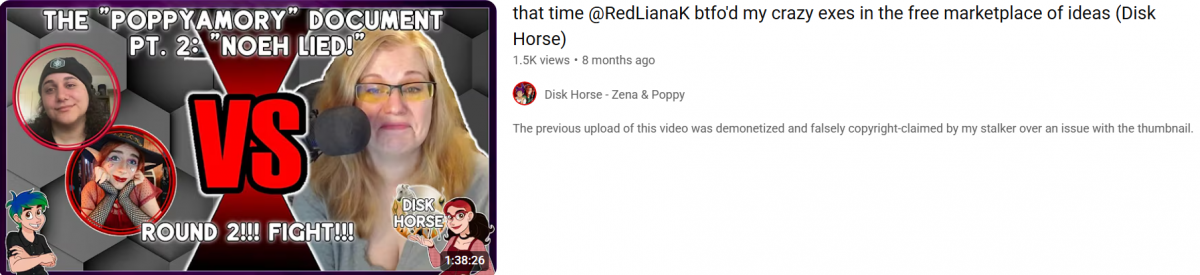
After all, Audrey does not seem to have much of an objection to keeping company with abusers, and defenders of abusers: She frequently re-skeets the passive-aggressive vague-posts Mrs. Kerzner makes every time she is aggrieved by someone (sometimes us) taking issue with her, or after she has shed yet another acquaintance or community member. This is the same Mrs. Kerzner who not only actively threw my husband under the bus to defend Poppy's honor from being called manipulative, but who has also spent a combined four hours of air-time defending Poppy. She has done so in videos such as 'That time @redlianak btfo'd* my craxy exes' (screenshot, not a link to the video dear reader- I would not subject you to that, but it's telling that both so-called mental health advocates and anti-stigma warriors feel so cavalier about tossing sanist terminology to discredit opponents) and another video where she 'deconstructs the Poppyamory doc' on Poppy's channel. The Poppyamory document is a compilation document outlining evidence of Poppy's alleged abuses by her alleged victims, which Mrs. Kerzner went over -selectively- in order to argue against its veracity.

Also part of that four hour via dolorosa (for the audience) is an interview of Poppy and Zena on Mrs. Kerzner's radio show where she floats the dubious and ethically dangerous notion that individuals suffering with borderline personality disorder are not capable of giving consent while symptomatic, placing responsibility for their actions on their partners, loved ones and everyone else around them. This is the argument under which Poppy, in that same interview, alleges her at-the-time lover Noeh sexually assaulted her because Noeh engaged in an intimate encounter with her and then subsequently broke up with her after the visit.
At this point it needs to be highlighted that Saige, upon exiting the 'Poppycule' (circa December 2024), has now joined the voices of Poppy's detractors, speaking openly about abuse and manipulation at her hands. Yet her girlfriend doesn't seem to be bothered that much by the work of an abuse apologist (for that is what Mrs. Kerzner would be in their eyes, as a defender of Poppy's) to the point that she still engages with her. Likewise Mrs. Kerzner, who still interacts regularly with Poppy and is part of her community, doesn't see fit to condemn Saige for using the same labels for which my husband was vilified, ostracized, and made the scapegoat of her project cancellation. Similarly, Audrey likes to re-skeet Saige's abuser's biggest supporter but somehow is labeling us as abusers because we would not cede them the distinction of being Poppy's only relevant victims.
The entire affair is astonishingly cult-like and luridly possessive of Poppy-as-abuser, where there is a gladiatorial stand-off for the privilege of being for-or-against the notion, but with a strange truce where the parties involved will immediately and violently turn on anyone they see as a risk of intruding upon their medieval Karpman triangle roles of inquisitor or white knight. Like the unspoken camaraderie of a group of associates keeping kayfabe.
If Audrey truly believed I was an abuser or defended abuse, in view of all of this, she wouldn't have blocked me- if I allow myself the luxury of being mordant, I might go as far as saying that she would be gladly re-skeeting my posts.
Perhaps the final framing of this surreal landscape can be contextualized by something my husband said early, early in his interaction with Saige and Audrey. When he described the behavior of Poppy, Kerzner et al, he said

In retrospect, it is extremely prescient to note how many of those points that Asher enumerated were snapped up by Audrey and Saige in the resulting conversation. It is almost Tyresias-like, since everything from the legal implications (where it is implied anyone disagreeing with Saige's paragraphs should be legally barred from having electronics) down to the mental health stigma were cycled through. You can go through both (so far) blog posts about this situation and use his post as a checklist for behavior exhibited.
I am aware that deprogramming doesn't happen overnight, and that the habits that Poppy encourages in her community are deeply toxic and maladaptive, where so much of her community works as an extension of her dysfunctions. Nevertheless, to pretend this behavior is no longer present in Saige would be to infantilize her and coddle her. I am not aware of what level of involvement Audrey had with the Foundation nor how long she was part of it, but this is nevertheless not encouraging. A pessimistic view would be to think that they will not hold each other accountable for the inconsistencies and behaviors outlined over the last two posts and, instead, rationalize them so that they don't have to be dealt with. If Saige truly wants a life and a relationship that is free from the shadow of the Foundation, these are the things they need to address.
Perhaps the final word in this section should be given to another one of Saige's favorite quotes from Schulman's book, on page 95 of the Kindle edition:

I wish I didn't have to point this out, but this was meant to be an admonition, not a roadmap.
Publicly Public
Finally, all of the material presented here has been publicly shared by Saige and Audrey themselves on their timelines. I have shared no actual private information nor gone out of my way to look into their personal lives and identities outside of what they show on their timelines. Audrey herself has shared a private conversation she had with Zena, in order to highlight Zena's extreme callousness regarding Saige's well-being. That particular instance gave me pause, and made me entertain the question of whether that violation of someone's sacrosanct privacy (according to Saige's standards) could be justified. If so, then, how much of Saige's original intransigent stance can remain intact? Would Audrey, by necessity, have to be barred from owning electronics after sharing that?
None of this is meant as 'stalking' or 'harassment', unless you wish to define 'taking an interest in the thoughts and consistent and inconsistent actions of the people accusing you of something' as 'stalking'. We are adults, and Audrey has leveled some serious accusations against us in public, and so we answer in public and we examine the data that exists in public to form our own opinions on the sincerity and nature of their actions.
To expect that we would not defend ourselves nor build a case to highlight what is being done is to either be naive or to adhere to the abuser's playbook where we are expected to 'shut up and take it,' as Audrey put it herself. Anyone can and is invited to go through my own timeline and highlight my inconsistencies where they may find them, hopefully so I can find ways to improve.
Where Saige and Audrey have been victims of harassment, however, is in the situation outlined in my warning about malicious impersonation. What has been done is truly abhorrent and condemned by both of us. We believe in a world where adults should be able to openly have disagreements and deal and live with them, and respect each other's fundamental rights regardless of how much dislike is engendered between them.
This brings me to my closing prediction.
The Next Step
We have seen a steady progression that mirrors Asher's original exchange with Poppy (which will eventually be covered in full detail): from the original assertion that we did not understand what was being spoken, an attempt to manipulate the narrative by shifting terms and subjects (insisting somehow that the topic was a comparison of victimization) to dismissal, and finally the leverage of mental health stigma.
When each one of these tactics failed, Poppy reached for the accusation of transphobia, implying that 'manipulative' (Saige's own word for Poppy now) was a transphobic stereotype, subsequently getting someone with a larger audience (Mrs. Kerzner) to blast my husband and blacken his reputation and moral fiber.
Since attempts to control the narrative have proven unsuccessful, and these two ex-Foundation members have followed Poppy's playbook so far, it stands to reason to think that this may be the next step. This post will be archived by archive.org to preserve this original prediction at the time that it is made, for the sake of posterity. I hope I am wrong, but so far it has been disappointing. None of this was necessary, but it was made necessary by the choices of the individuals involved, just as Mrs. Kerzner and Poppy's choice made our own contentious relationship necessary.
The original accusation of transphobia is, of course, ridiculous, as are any that follow in that vein. Our criticism of Poppy, Saige and Audrey rests along the same vein that our criticism of all the women and the men we have had disagreements with rests: Behavior and integrity, not identity. As individualists who welcome the transhumanist ideals of self-determined identity and self, we recognize every person's right to their own sense of identity. Poppy, Saige and Audrey are women and we will always address them as such. We do not believe that the behaviors to which we object are rooted in their identity nor that there is some inherent quality in it that is their cause.
We may not respect their actions and what they in turn suggest about them, nor do we like them as individuals, but it is possible to dislike someone while also respecting and advocating for their rights and autonomy as human beings. There is no amount of anger or a disagreement so large that it could ever convince us that a trans person deserves to have rights removed or suffer injustice and worse over the fact that they are trans. We do not hold that those who disagree with us should be restrained by law- only those who perpetrate actual harm.
Comments